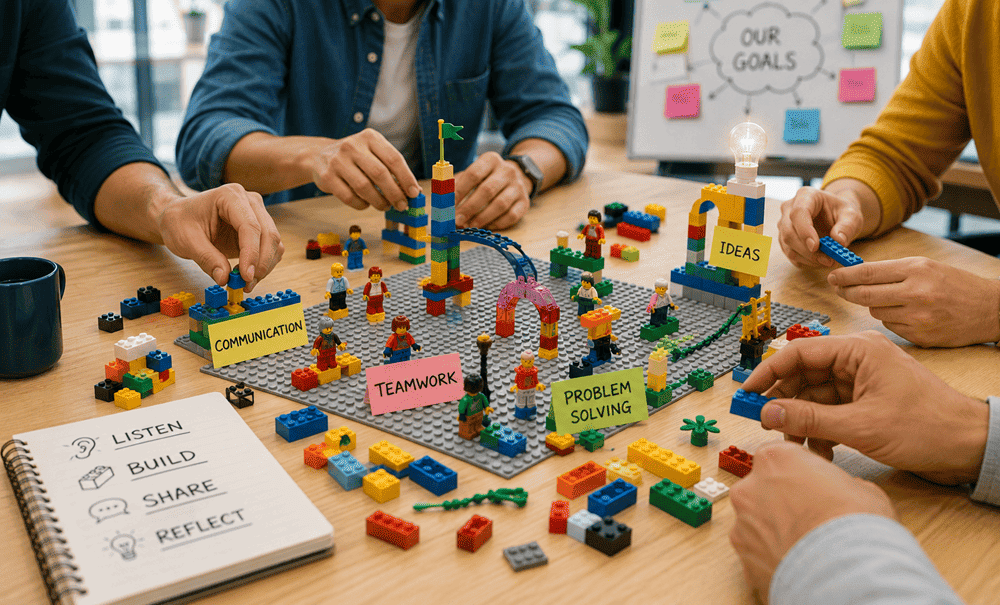
LEGO Serious Play is a hands-on team-building method where people use LEGO bricks to build models, share ideas and explore workplace challenges together.
Instead of relying solely on lengthy discussions, teams turn their thoughts into simple LEGO models and explain what those models represent. This gives everyone a clear way to participate, including people who may be less comfortable speaking during group meetings.
LEGO Serious Play team building works because it makes ideas easier to visualise, share and discuss. Teams can explore challenges, compare different perspectives and find common ground without allowing one person to dominate the conversation. It can also support trust, creative thinking and stronger team alignment, making it useful for strategy sessions, leadership workshops and team development.
The Methodology Behind LEGO Serious Play
LEGO Serious Play follows a simple process: build, share and reflect. A facilitator presents the team with a question or challenge, and each participant builds a LEGO model to represent their thoughts or ideas.
-
Building Metaphors
LEGO bricks help participants turn abstract thoughts into physical metaphors. For example, a bridge may represent cooperation, while a wall may symbolise communication barriers. The meaning behind the model is more important than its appearance or building quality.
-
Storytelling
After building their models, each participant shares the story behind their creation and explains what it represents. This gives everyone an opportunity to express their ideas and perspectives.
-
Reflection
Lastly, the team examines the models together and discusses what they mean. Participants may identify common themes, differences and possible solutions through the models and the conversations they create.
What Teams Gain From LEGO Serious Play
LEGO Serious Play team building is more than a creative activity. It gives every team member an opportunity to share ideas, understand different perspectives and work towards a common goal.
- Psychological safety: Discussing the model can make it easier to explore difficult issues. Team members can focus on the challenge itself rather than directing criticism towards an individual.
- Improved alignment: Everyone can demonstrate their view of an objective, problem or situation. The team can compare different perspectives and develop a clearer shared understanding.
- Creative problem-solving: Building models encourages teams to approach challenges from different angles. New insights and possible solutions can emerge through discussion and reflection.
- Equal participation: As everyone builds and presents something, quieter team members may find it easier to contribute alongside more outspoken colleagues.
- Improved communication: Models can help people discuss abstract or complex issues in a clearer and more engaging way.
- Stronger team trust: Listening to different perspectives allows team members to better understand how their colleagues think and approach challenges.
- Shared ownership: When people are involved in developing ideas and solutions, they are more likely to understand and feel connected to the outcome.
For organisations exploring LEGO Serious Play in Singapore, these benefits can make the method a useful option for teams with different roles, working styles and perspectives. The structured format encourages everyone to participate, share ideas and work towards a clearer understanding of team goals.
What a LEGO Serious Play Session Looks Like
A LEGO workshop for teams works best when it starts with a clear purpose. Whether the focus is communication, strategy or team alignment, each activity should connect to a challenge the group wants to understand or solve.
1. Start With a Warm-Up
The facilitator explains the LEGO Serious Play process and begins with a few simple building activities. This helps participants become familiar with the bricks and understand that no building experience or creative skill is required. The focus is on using models to represent ideas rather than creating something visually impressive.
2. Explore a Team Challenge
The facilitator then introduces a clearly defined question linked to a real workplace situation. This could relate to communication, trust, leadership, goal-setting or an existing challenge. A well-defined question helps focus participants’ thinking and gives the activity a clear purpose.
3. Build Individual Ideas
Each participant creates a model using LEGO bricks to represent their interpretation of the challenge. Shapes, figures, colours and structures can symbolise different concepts, relationships or experiences. The meaning behind the model is far more important than its appearance or level of complexity.
4. Share the Story
Once the models are complete, participants take turns explaining what they have built and what the different elements represent. Each person has an opportunity to share their perspective. This can help the group uncover ideas or insights that may not emerge during a conventional discussion.
5. Discuss the Models Together
The group examines the models and identifies common themes, differences and connections. Participants can ask questions and explore why others may view the same challenge from a different perspective. This process can lead to a deeper understanding of the issue and the people involved.
6. Create a Shared View
The team can then combine individual ideas to create a shared LEGO model. This may represent a common goal, team strategy or preferred way of working. By building the model together, participants can discuss priorities and develop a clearer understanding of what matters most to the team.
7. Reflect and Decide What Comes Next
Lastly, participants reflect on what they have learned and decide on the next steps. The facilitator helps translate key insights into practical actions or follow-up points. This process can also be incorporated into a broader team bonding workshop focused on communication, collaboration or team development.
Best Use Cases for LEGO Serious Play
The LEGO Serious Play method is particularly useful when teams need an open and structured way to generate ideas, solve problems and explore different perspectives. It can be applied to a range of workplace situations, including:
- Strategy workshops: Participants can turn plans and ideas into models, identify potential challenges and develop a shared vision for the future.
- Leadership offsites: Leaders can explore priorities, communication styles and the challenges involved in leading teams and managing change.
- Team alignment: Team members can examine their roles, objectives and responsibilities while developing a clearer understanding of how they work together.
- Problem-solving sessions: Building models can help participants examine challenges from different angles and identify possible solutions.
- Change management workshops: Teams can discuss concerns, expectations and opportunities linked to organisational change in a more open and structured way.
- New team development: New teams can gain a better understanding of how their colleagues think, communicate and approach challenges.
- Culture and values sessions: Participants can turn abstract ideas, such as trust, teamwork and company values, into tangible models and examples.
For teams looking for creative team-building methods, LEGO Serious Play can be a strong choice when the objective goes beyond simply having fun and focuses on meaningful discussion, deeper understanding and shared outcomes.
Conclusion
LEGO Serious Play team building can be effective because it changes the way people think, collaborate and solve problems together. Unlike traditional team discussions, where the most confident or outspoken participants may influence the direction of the conversation, the structured process gives everyone an opportunity to build, share and explain their ideas.
The method can help bring out new or previously unspoken ideas while making difficult or sensitive topics easier to discuss. Different perspectives become visible through the models, allowing teams to explore them together and work towards possible solutions. The hands-on format also encourages active participation rather than leaving some participants as passive listeners.
For teams working through strategic issues, communication challenges, leadership questions or alignment, LEGO Serious Play is more than simply playing with plastic bricks. It provides a structured process for encouraging discussion, exploring ideas and developing a shared understanding. When facilitated effectively, the method can add greater depth and value to an ordinary team discussion.
Build a Stronger Team Through Play
Ready to give your team a more engaging way to connect, communicate and solve problems? Explore EKA Team Building’s hands-on corporate experiences and find a workshop that brings fresh thinking, stronger relationships and shared goals into the workplace.