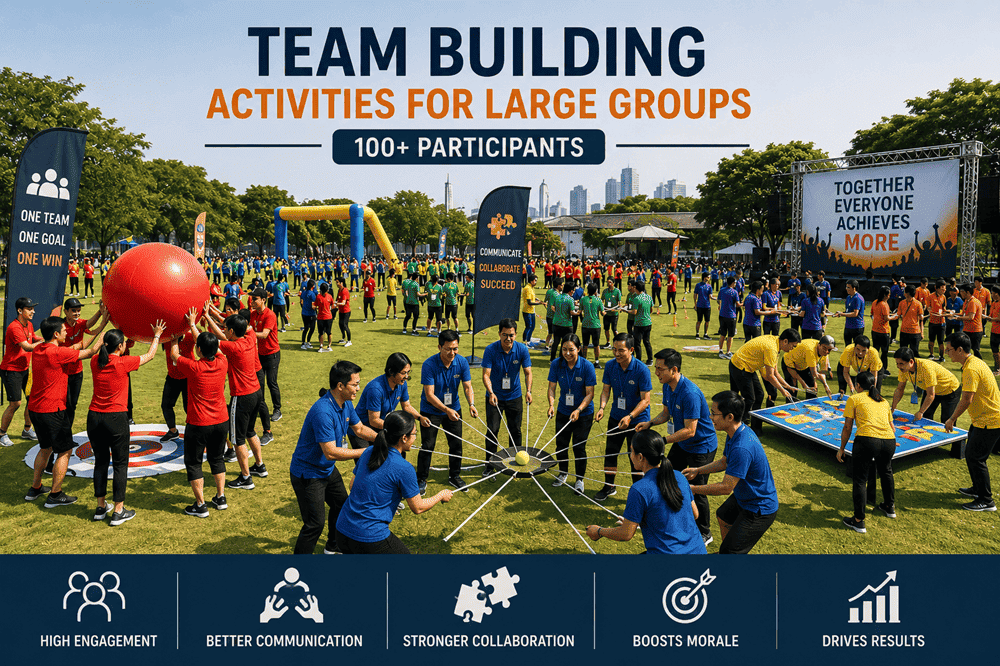
The best team building for large groups of 100 or more participants are those that keep everyone involved without creating long queues or complicated logistics. For most corporate groups, three formats scale particularly well: multi-station rotations, race-style challenges and large collaborative or CSR builds.
Multi-station activities divide a large crowd into smaller teams that rotate between challenges. Race-style events, such as an Amazing Race or Gumball Rally, spread teams across different checkpoints. Meanwhile, large collaborative builds bring everyone together to work towards a shared goal.
The right choice depends on your group size, venue, budget and event objectives. For HR and People teams, the priority should be simple: choose a format where every employee has an opportunity to participate, connect and contribute.
Challenges of Large-Group Team Building
Planning a team-building session for a larger group is more complicated than organising an activity for a smaller team. Once you have more than 100 participants, three important factors should be considered carefully:
- Logistics: For corporate events for 500 employees, divide the venue into clear zones and plan how teams will move between them. This helps prevent bottlenecks and makes it easier for facilitators to manage each group.
- Engagement: Keeping everyone involved can be challenging in a large group. Activities that give each participant a role and allow multiple teams to take part at the same time are usually more effective.
- Facilitation ratio: Too few facilitators can lead to confusion and delays. Ensure there are enough facilitators at each station or activity area to guide teams and keep the programme running smoothly.
Addressing these challenges can help ensure that your team-building session runs smoothly and gives employees more opportunities to interact, network and compete.
Best Activities for 100+ Participants
When choosing large group team building activities in Singapore, look for formats that keep people moving without creating long queues. The following activities can be adapted to suit different venues, group sizes and company objectives.
Amazing Race
An Amazing Race turns team building into a series of challenges across different checkpoints. Teams follow clues, solve problems and complete tasks to earn points. As groups can begin at different locations, the format works well for large numbers without creating crowds in one area.
- Best for: Communication, problem-solving and friendly competition.
- How it scales: Divide participants into smaller teams and assign different starting checkpoints or routes.
- Key benefit: Keeps large groups moving while giving every team a clear objective.
Human Foosball Stations
Human Foosball brings the classic table game to life, with employees working together as the players. Team members must coordinate their movements to defend, pass and score. For larger groups, several short matches can run alongside other activity stations.
- Best for: Team coordination, communication and high-energy interaction.
- How it scales: Run several stations or short rounds while other teams complete nearby challenges.
- Key benefit: Creates plenty of interaction without complex rules or long briefings.
Gumball Rally
A Gumball Rally sends small teams through a set of checkpoints, challenges and missions. Each team works towards a final goal while collecting points along the way. Different routes and starting points help spread participants across the venue.
- Best for: Problem-solving, teamwork and a sense of adventure.
- How it scales: Create several routes and stagger starting points to reduce queues between challenges.
- Key benefit: Combines different types of tasks, so employees with varied skills can contribute.
You can also include simple challenges from other team building events to add more variety to rally checkpoints.
Multi-Station Rotation Formats
Multi-station rotations divide a large group into smaller teams that move between different activities. Each station can focus on a skill such as communication, creativity, coordination or problem-solving. As several challenges take place simultaneously, hundreds of participants can remain active throughout the event.
- Best for: Mixed groups, varied activities and full-day corporate events.
- How it scales: Add more stations, duplicate popular challenges or create separate activity zones as participant numbers increase.
- Key benefit: Reduces waiting time and gives organisers greater control over crowd movement and participation.
Mass CSR Builds
Mass CSR builds bring employees together to support a shared social or community goal. Smaller teams can work on different parts of the same project, such as preparing care packs or assembling useful kits. Their individual efforts then come together as one larger contribution.
- Best for: Purpose-led events, collaboration and mixed-age groups.
- How it scales: Divide the project into simple tasks that multiple small teams can complete at the same time.
- Key benefit: Gives employees a shared sense of purpose while allowing everyone to make a clear contribution.
The right format depends on your group size, venue and objectives, but each of these activities can keep 100 or more participants involved without making the event difficult to manage.
Logistics Checklist for Big Events
Good logistics can make or break team building for large groups. Before the event begins, make sure these four areas are planned around your group size, venue and activity format.
- Facilitator ratio: Have enough facilitators to manage each team, station or activity zone. Clear staff roles help participants receive instructions quickly and keep the event moving smoothly.
- Staging: Map out registration areas, activity zones, walkways and meeting points. Leave enough space for teams to move around without creating queues or overcrowded areas.
- AV set-up: Use microphones, speakers and screens when instructions need to reach the full group. Test all equipment before participants arrive and keep a backup option available.
- Catering: Plan serving times, food stations, seating and dietary requirements around the event schedule. For large groups, several serving points can help reduce queues and keep breaks running on time.
A clear logistics plan means less waiting, fewer delays and more time for employees to enjoy the activities.
Budget Considerations at Scale
The cost of team building for large groups depends on more than the activity itself. Group size, venue, staffing and event set-up can all affect the final budget, especially for events involving 100 or more participants.
| Cost area | What affects the cost? | Planning tip |
| Activities | Equipment, materials and number of stations | Choose activities that can accommodate several teams at once |
| Venue | Capacity, location and event duration | Select a space that suits your activities without paying for unused areas |
| Facilitators | Group size and number of activity zones | Budget for enough staff to keep each station running smoothly |
| AV & staging | Speakers, microphones, screens and setup | Confirm what the venue already provides before hiring equipment |
| Catering | Number of guests, menu and dietary needs | Compare per-person packages and plan several serving points |
For large corporate events, compare the total cost per participant rather than the activity fee alone. You can also explore our full range of programs to compare formats and find an option that suits your group size, objectives and budget.
Conclusion
Successful team building for large groups comes down to structure, not simply the game you choose. For 100 or more participants, race formats, station rotations and large collaborative builds give organisers the flexibility needed to keep people active and connected.
Plan team sizes, facilitation, movement, AV, catering and backup options before the event day. More importantly, choose an activity that suits your workforce rather than simply choosing the loudest or most complicated idea.
When each person has a clear role and teams spend more time participating than waiting, scale can become an advantage. The best big team building ideas are not always the most complex. Choose activities that are easy to understand, simple to scale and flexible enough to give every employee a meaningful role.
Planning a team building event for 100, 300 or even 500+ employees?
Get in touch with EKA Team Building to plan a team building program that keeps everyone involved from start to finish. From choosing the right activity format to managing the event flow, our team can help you create a smooth and engaging experience that fits your group size, goals and budget.