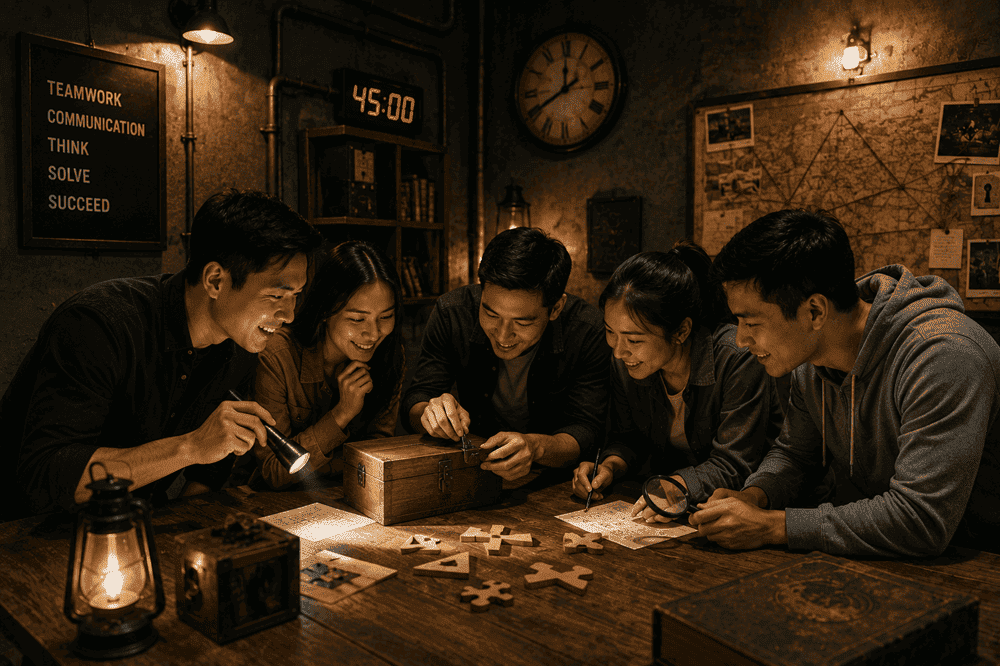
Escape room team building works because it puts colleagues in a shared challenge where communication, problem-solving and teamwork matter. Teams search for clues, solve puzzles and make quick decisions while working against the clock. This creates a fun setting where people can see how well they listen, share ideas and respond under pressure.
During an escape room corporate event, teams usually start with a short briefing before entering a themed room for around 60 minutes. They work through puzzles together, ask for hints when needed and finish with a debrief to discuss the experience. For companies looking for an engaging team activity, escape rooms offer a simple way to build stronger working relationships while giving everyone a chance to contribute.
The Psychology Behind Escape Room Team Building
Escape rooms require teams to work together to solve puzzles within a set amount of time, making communication, critical thinking and problem-solving essential. As team members work towards a common goal, they naturally learn to collaborate, cooperate and make decisions together.
A Shared Problem Gets People Talking
Escape rooms cannot usually be solved by one individual alone. Players need to exchange information, share what they have discovered and discuss different ways to progress through the room. One player might notice a clue, while another may be able to connect it to a puzzle or solution.
This makes escape rooms one of the most engaging problem solving team activities, as everyone can play a role in finding clues, sharing ideas and working towards the final solution.
Pressure Reveals Natural Roles
A countdown can quickly highlight how different individuals respond under pressure. Some naturally take on leadership roles and organise activities, while others are good at noticing details, spotting clues or testing possible solutions.
These strengths often emerge naturally during the game, giving colleagues a chance to see abilities in one another that may not usually be visible in the workplace. A quieter colleague, for example, may turn out to be particularly skilled at recognising patterns or solving complex puzzles.
Teams Learn to Change Direction
Not every idea will lead to the right result, so teams need to adapt when an approach is unsuccessful. If one solution does not work, players must decide whether to continue or try another strategy.
This encourages people to listen to alternative suggestions rather than becoming stuck on one particular idea. Escape room team building provides a safe environment for teams to practise adapting, changing direction and learning from unsuccessful attempts without the risks associated with real workplace decisions.
What to Expect on the Day
An escape room corporate event usually follows a simple format, so first-time players do not need to worry. From the opening briefing to the final discussion, each stage helps the team understand the game, participate fully and work towards a shared goal.
1. Arrival and Briefing
The experience begins with a short welcome from the host. They go through the rules, explain the theme of the room and demonstrate how the clue or hint system works. For larger corporate events, participants may also be divided into smaller teams before entering their respective rooms.
2. The Game Begins
As soon as the timer starts, participants begin searching for clues, solving puzzles and identifying connections within the room. The challenges may involve numbers, words, patterns or physical objects. Players need to collaborate and communicate to make sense of the information they discover.
3. The Team Works Against the Clock
The time limit adds excitement while encouraging groups to think, communicate and make decisions together. Players may divide tasks and work on several puzzles at the same time. Clear communication is especially important, as a clue discovered by one person may save valuable time for the entire team.
4. The Game Ends
The game ends either when the team solves the final puzzle or when the time runs out. Escaping within the time limit can be highly satisfying, but it is not the only measure of success. Even if a team does not complete the room, the experience can still reveal useful insights into how members communicate, collaborate and respond to challenges.
5. Debrief and Discussion
After the game, teams can discuss what worked well, what caused difficulties and which moments stood out. They may also reflect on the different roles people took on during the challenge. A short debrief helps connect the experience to communication, problem-solving and teamwork in the workplace.
Ideal Group Sizes and Duration
When planning a team building escape room in Singapore, check the room capacity before booking. Smaller groups often give each person more chances to share ideas, solve clues and take an active role. For most escape rooms, groups of four to six people offer a good balance between teamwork and active participation.
| Group size | Typical experience | Suggested game time |
| 2–3 people | Fast-moving but demanding | 45–60 minutes |
| 4–6 people | Strong balance of ideas and participation | 60 minutes |
| 7–8 people | More viewpoints but requires clear communication | 60 minutes |
| 9+ people | Best divided across several rooms | 60–90 minutes overall |
Escape Room vs Other Indoor Activities
An escape room is not the only way to bring a team together. There are many indoor team building activities that can help colleagues connect, communicate and enjoy time away from their usual work environment.
| Activity | Best for | Physical level | Team interaction | Typical duration |
| Escape room | Communication and problem-solving | Low | Very high | 60–90 mins |
| Creative workshop | Relaxed bonding and creativity | Low | Medium | 1.5–3 hours |
| Indoor sports | Energy and friendly competition | Medium–high | High | 1–3 hours |
| Cooking challenge | Cooperation and social bonding | Low–medium | High | 2–3 hours |
| Quiz or game show | Large groups and light competition | Low | Medium–high | 1–2 hours |
If weather, comfort or venue access matter, there are many other indoor team-building options worth considering.
Tips to Get the Most Out of Escape Room Team Building
A little planning can make escape room team building more enjoyable and rewarding. Keep these simple tips in mind before your team enters the room:
- Choose a difficulty level that suits your team’s experience.
- Keep groups small so everyone has a chance to take part.
- Mix people from different teams or departments to encourage new connections.
- Let leadership roles develop naturally during the game.
- Encourage everyone to share clues and ideas with the group.
- Use hints when the team gets stuck for too long.
- Focus on teamwork rather than simply trying to finish first.
- End with a short debrief to discuss what the team learned.
With the right approach, an escape room can become a fun and engaging experience that brings colleagues closer and strengthens teamwork.
Conclusion
Escape room team building works because the activity gives people a clear reason to cooperate. Teams need to share information, test ideas, manage their time and adapt when a plan does not work. At the same time, the game keeps these challenges fun and low risk.
The strongest sessions are not always the ones where teams escape the fastest. A meaningful experience gives everyone space to participate and creates something worth discussing afterwards.
When planning a session, focus on the right group size, a suitable difficulty level and enough time for a short debrief. These choices can turn a simple escape game into an experience that helps colleagues better understand how they work together.
Ready to give your team a fresh challenge?
Explore EKA Team Building’s corporate activities and plan an experience that brings your team together through fun, communication and shared problem-solving.