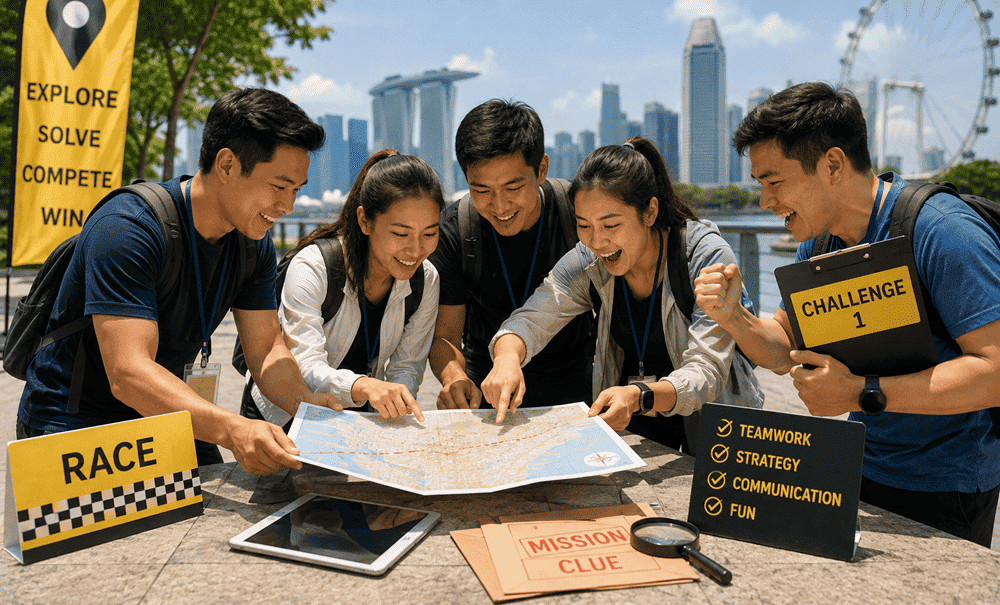
Amazing Race team building is a group activity where teams follow clues, move between checkpoints and complete challenges to earn points or reach the finish line.
The format turns a normal team day into a shared race filled with puzzles, decisions and fun tasks. Each team must communicate, manage its time and use different strengths to keep moving.
The rules can also be adapted to suit your group size, venue and objectives. You can run the race across a park, around city landmarks or within a single event space. A well-planned race gives everyone a role and keeps teams involved from start to finish. Here is how Amazing Race team building works, the skills it develops and what you need to plan a successful event.
How Amazing Race Team Building Works
The flexible format is one reason race-based team building activities work well for many corporate groups. Organisers can adjust the clues, checkpoints and difficulty level according to the team’s objectives, size and available time.
Step 1: Divide Participants Into Teams
Begin by dividing participants into smaller groups of around five to eight people. Each group should be briefed on how the game works, including the rules, time limits, scoring system and any other important considerations.
Teams may also choose their own names or colours before the race begins. This can add a fun element of competition and help create a stronger sense of team identity from the start.
Step 2: Give Teams Their First Clue
Each team receives a clue leading to its first destination. The clue may take the form of a riddle, photograph, puzzle or a set of simple directions.
The clues should be challenging enough to encourage discussion but not so difficult that they delay the race for too long. The aim is to get participants thinking and communicating while keeping the activity moving.
Step 3: Reach the Stations
Once a team solves its clue, members move to the correct station. Checkpoints can be spread across a park, an event venue or selected locations around Singapore.
Each station should offer a different challenge. This may involve solving a puzzle, completing a memory task, taking part in a physical activity or working together to complete a creative challenge.
Step 4: Complete Each Checkpoint
A facilitator confirms that the team has completed its challenge. Once the task is completed, the team receives its next clue or instructions for reaching the following checkpoint.
For larger groups, teams can begin at different checkpoints. This helps reduce queues, prevents overcrowding and keeps the race moving smoothly.
Step 5: Collect Points
Teams can earn points for completing each station. Bonus points may also be awarded for teamwork, fast completion or optional challenges.
Time penalties for skipped tasks or additional hints can also be included. However, the scoring system should not rely on speed alone, as this may place some participants at a disadvantage and reduce opportunities for different strengths to contribute.
Step 6: Finish the Race and Calculate Scores
All teams gather at the final checkpoint before the allotted time ends. Scores are then totalled, with any bonuses or deductions applied.
The team with the highest score wins. This approach ensures that effective decision-making, collaboration and successful completion of challenges are rewarded rather than speed alone.
Skills Amazing Race Team Building Develops
Amazing Race team building places people in situations where they need to think, communicate and make decisions together. As each challenge is different, team members can use their individual strengths while working towards one shared objective.
- Problem-solving: Teams solve clues, puzzles and challenges within a limited time. This gives participants opportunities to analyse ideas, test possible solutions and make decisions together.
- Time management: Teams have limited time to complete the race. Members need to decide which tasks to prioritise and how long to spend at each checkpoint.
- Cross-team collaboration: Bringing together participants from different teams or departments can help create new workplace connections. Colleagues who may not usually work together have an opportunity to collaborate on a shared challenge.
- Effective communication: Clear communication helps teams understand clues, divide tasks and share useful information. It can also reduce confusion when time pressure increases.
- Decision-making: Teams may need to make decisions about routes, tasks or possible answers. This encourages participants to make choices efficiently, even when they do not have complete information.
- Leadership and teamwork: Different people may naturally take the lead at different stages of the race. One person may excel at solving puzzles, while another may be better at planning routes or coordinating the team.
These skills can carry back into the workplace. Teams gain a better understanding of how their colleagues think, communicate and respond when they are working together to solve a shared challenge.
Ideal Group Size and Duration
When planning a corporate Amazing Race in Singapore, consider both the number of participants and the space available at each checkpoint. Larger groups may require more stations, staggered starting times and different route orders to keep the race moving smoothly.
| Total participants | People per team | Suggested duration |
| 10–30 | 4–6 | 1–2 hours |
| 30–60 | 5–7 | 2–2.5 hours |
| 60–100 | 6–8 | 2.5–3 hours |
| 100+ | 6–10 | 3–4 hours |
For larger corporate groups, use several starting points or different route orders. This helps prevent queues at popular checkpoints and gives each team more time to focus on the challenges.
Popular Route Themes in Singapore
There are many Amazing Race event ideas to choose from, so the route does not have to follow one fixed format. Heritage trails, nature challenges, photo hunts and food-themed routes can all create different experiences while keeping teamwork at the centre of the event.
- Heritage Discovery Theme: Create a route through Chinatown, Little India or Kampong Glam. Clues can be based on the area’s history, architecture, culture and well-known landmarks.
- Marina Bay Theme: Make use of the popular landmarks around Marina Bay. Challenges may include photography tasks, observation activities and clues linked to notable locations.
- Nature Theme: Parks and green spaces are suitable for puzzle challenges, navigation tasks and light physical activities. The race can also be combined with other outdoor team building games.
- Foodie Challenge: Create food-related challenges around Singapore. Teams may be asked to answer food-related questions, identify ingredients or complete photography tasks involving local dishes.
- Photo Hunt Theme: Give teams a list of creative photographs they need to capture during the race. Extra points can be awarded for teamwork, creativity or completing all the tasks within the time limit.
- Sustainability Race: Checkpoints can focus on environmental topics such as nature, recycling and sustainable practices. This theme can work well for companies that want to connect team building with their sustainability goals.
Choose a theme that suits your team and event objectives. More importantly, keep the distance between checkpoints manageable so participants spend more time completing challenges than travelling between locations.
What to Prepare Beforehand
A smooth Amazing Race event depends on careful planning. Before teams arrive, check the route, clues, equipment and safety arrangements so everyone knows what to expect.
Use this checklist before the event day:
- Set a clear goal: Decide whether the activity is intended to improve communication, strengthen relationships, encourage collaboration or simply provide a fun team-building break.
- Choose the route: Select routes that are safe and easily accessible. Travel the entire route beforehand and estimate how long it takes to move from one checkpoint to the next.
- Plan the stations: Create different challenges for each station. Include a mixture of puzzles, observation games and light physical activities so participants with different strengths have opportunities to contribute. You may also include activities such as archery team building in Singapore as part of a station-based outdoor challenge.
- Prepare and test the clues: Write clear clues and ask someone else to test them. This can help identify clues that are too easy, too difficult or potentially misleading.
- Create a scoring system: Decide how teams earn points. Clearly explain any bonus points, time penalties and rules relating to skipped stations or challenges.
- Arrange facilitators: Position facilitators at key checkpoints to provide instructions, manage equipment and confirm scores or completed tasks.
- Prepare for the weather: Singapore’s weather can be hot or rainy, so prepare suitable contingency plans and consider how activities can continue if conditions change.
- Check safety requirements: Identify potential hazards such as busy roads, uneven ground or slippery surfaces along the route. Ensure emergency supplies and relevant contact information are readily available.
- Prepare all equipment: Check clue cards, pens, scorecards, mobile phones, props and station equipment before participants arrive.
- Brief the teams: Explain the rules, boundaries, time limits, scoring system and other important information before the race begins.
A final check of the route can help prevent unexpected issues on the day. It also helps ensure that every checkpoint is available, safe and accessible for all participating teams.
Conclusion
Amazing Race team building can transform an ordinary corporate outing into an engaging shared challenge. Teams compete to solve puzzles, reach checkpoints and complete tasks within a set time limit. Along the way, participants practise communication, problem-solving and time management in a setting that feels different from their usual work environment.
The most successful events are not necessarily the fastest or most difficult. Instead, they give every participant an opportunity to contribute, share ideas and use their individual strengths. Clear instructions, a good variety of challenges and a fair scoring system can also make the experience more enjoyable and inclusive.
A carefully planned route, well-balanced activities and appropriate safety measures can help colleagues build stronger connections. This type of team building encourages participants to step outside their usual roles and work towards a shared goal, while also offering an opportunity to explore Singapore in a different way.
Ready to Plan Your Next Team Challenge?
Bring your team together with an activity that combines friendly competition, problem-solving and plenty of shared moments. EKA Team Building can help you create an engaging experience suited to your group size, goals and preferred setting in Singapore.
Explore the available programmes and start planning a team day that gets everyone involved.